English | Português

Education Research Events Service Units Media & Public Support Us

Tissue Morphogenesis

Research Interests

Our focus is the analysis of fundamental mechanisms of tissue morphogenesis in the zebrafish embryo, using high-resolution live microscopy in combination with genetic and embryological techniques.
Epithelial tissues are a key feature of all multi-cellular life, contributing to the shape and integrity of the body and its organs. Epithelia can undergo dramatic changes in shape and organization, a fascinating ability that is only poorly understood. The zebrafish embryo is ideal to make new advances in this field, in particular because of the ease of applying genetics and live imaging. Specifically, we are interested in the morphogenetic behaviour of the embryonic surface epithelium, the enveloping layer (EVL). During the first few hours of zebrafish development, the EVL enwraps and seals the embryo in a process called epiboly. This process is of general interest, since it occurs in many developmental contexts as well as during the healing of wounded tissue. Interestingly, we recently found that the EVL plays a central role during the formation of the first zebrafish organ, Kupffer’s vesicle. The laboratory will therefore pursue two main lines of investigation; (1) Analysis of the cellular and molecular mechanisms that control the spreading and sealing of the EVL; (2) Study of the origin and morphogenesis of Kupffer’s vesicle.

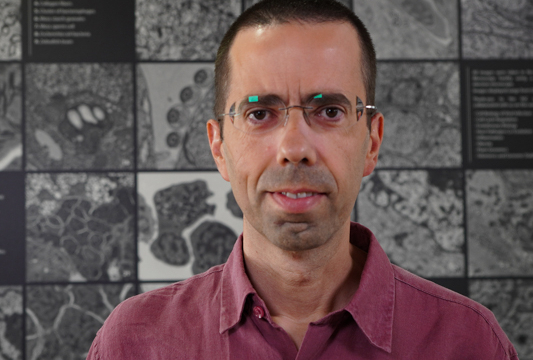
Mathias Koeppen

Ph.D. in Cell and Molecular Biology

University of Wisconsin, Madison


Principal Investigator
Phone 21 440 7957
Extension 257
Email
Location (Wing) Zheng Ho (C1) - Room 1C

Group Members

Ana Borges Postdoc
Tel: 21 440 7900
Inês Cristo External Ph.D. Student
Tel: 21 446 4659
Paulo Raimundo Trainee
Tel: 21 446 4659
Pedro Almada Visiting Und.Grad. Student
Tel: 21 446 4659


Research Project

Enveloping layer morphogenesis

Using functional genetics and live multi-photon microscopy, we have previously shown that EVL epiboly is driven by actin/myosin based contraction of the underlying yolk surface (the yolk syncytial layer, YSL). Both tissues are connected via tight junctions, which transmit the contractile force to the EVL. We therefore propose that the YSL acts as a motor that drives the movement and sealing of the EVL. Addressing the molecular mechanism, we found that actin and known tight junction components (including ZO proteins and Claudins) become simultaneously enriched at the interface between the EVL margin and the YSL. Importantly, morpholino-based knock-down of the tight junction protein ZO-3 impairs actin accumulation in the YSL and epiboly progression. This suggests an intriguing new role of tight junctions during morphogenesis.

Further pursuing this model, we will carry out an in-depth investigation of the tight junctions linking EVL and YSL. To determine junctional composition, we will use antibodies against tight junction molecules and perform live imaging of tagged proteins. The function of these components will be tested using morpholino-based gene silencing to study their role in actin recruitment and EVL cell constriction during epiboly. Conversely, the role of the cytoskeleton for tight junction based tissue linkage will be tested by specifically inhibiting the function of actin, myosin, and regulatory proteins.

In a complementary approach, we will directly determine local, contractile forces within the YSL using laser-cutting techniques. To understand how such forces alter tissue geometry, the overall pattern of EVL cell shape change during epiboly will be mapped. Combining genetic and biophysical approaches will lead to a more general understanding of tissue spreading and sealing.

Research Project

Kupffer’s vesicle formation

Kupffer’s vesicle (KV) is the zebrafish ‘organ of laterality’, which triggers left-right axis establishment similar to the mouse node. KV is a ciliated epithelial structure consisting of about 50 cells and is formed during the gastrulation and somitogenesis stages. KV formation serves as a simple model of organogenesis and involves key morphogenetic events such as mesenchymal-to-epithelial transition, cell cluster movement and lumen formation. These events can be observed at single-cell resolution by multi-photon microscopy and functionally studied using genetic tools. Interestingly, we have recently discovered that KV formation critically depends on the enveloping layer (EVL). Namely, a subset of EVL cells delaminate from the epithelium and form the precursor cells that then assemble into the vesicle. This directly links surface epithelial morphogenesis to organ formation.

Our functional analysis will focus on specific candidate proteins that are likely to be critical during vesicle formation. An important focus will be tight junction components, which mediate the attachment of vesicle precursor cells to the EVL during epiboly, and later play a key role in the formation of the functional organ.

In addition, genomics approaches will aim at identifying new factors that control the organogenetic process. We will make use of an existing transgenic zebrafish line that fluorescently labels the vesicle cells, allowing the isolation of these cells and gene expression profiling using microarrays. In addition, we have initiated a forward genetic screen for mutants with defective KV morphology using the same transgenic line. These approaches will reveal the genetic program underlying KV formation and identify new candidate molecules for investigation.

Publications

Oteíza, P.*, Köppen, M.*, Concha ML, Heisenberg CP. (2008). Origin and shaping of the laterality organ in zebrafish Development 135 :2807-13

Vervenne, HB, Crombez, KR, Lambaerts, K, Carvalho, L, Köppen, M., Heisenberg CP, Van de Ven WJ, Petit MM. (2008). Lpp is involved in Wnt/PCP signaling and acts together with Scrib to mediate convergence and extension movements during zebrafish gastrulation. Developmental Biology 320 :267-77

Qadota, H., Inoue, M., Hikita, T., Köppen, M., Hardin JD, Amano M, Moerman DG, Kaibuchi K. (2007). Establishment of a tissue-specific RNAi system in C. elegans Gene 400 :166-73

Köppen, M., Fernandez BG, Carvalho L, Jacinto A, Heisenberg CP. (2006). Coordinated cell-shape changes control epithelial movement in zebrafish and Drosophila Development 133 :2671-81

Köppen, M., Heisenberg CP. (2005). Cleavage and gastrulation in zebrafish embryos Encyclopedia Of Life Sciences [doi:10.1038/npg.els.0001072] Link

Simske, JS, Köppen, M., Sims PA, Hodgkin J, Yonkof A, Hardin JD (2003). The cell junction protein VAB-9 regulates adhesion and epidermal morphology in C. elegans Nat Cell Biol 5 :619-25

Köppen, M., Simske JS, Sims PA, Firestein BL, Hall DH, Radice AD, Rongo C, Hardin JD. (2001). Cooperative regulation of AJM-1 controls junctional integrity in Caenorhabditis elegans epithelia. Nat Cell Biol 3 :983-91