English | Português

Neurobiologia de Comportamento

Interesse da Investigação

We are interested in understanding the neural mechanisms underlying behavioral plasticity. To behave in an adaptive manner animals have to make decisions based on an evaluation of the current circumstances and on their past experiences. Evaluating the current situation involves perceiving cues in the environment (e.g. smell of food), internal cues (e.g. hunger), the possible payoffs (e.g. amount of food and probability of getting it), and the costs involved (e.g. effor the animal has to make in order to obtain the food). In order to rely on past experiences, animals have to be able to form, store and retrieve memories of past events (e.g. “I’ve been here before and found food”). We are particularly interested in studying the neural basis of memory formation, and payoff evaluation. To do so, we chose to focus on a particular behavioral paradigm, Pavlovian Fear Conditioning. During conditioning, a previously neutral stimulus, such as a tone, is paired with an aversive stimulus, such as footshock, so that the tone and shock co-terminate. Animals quickly learn that the tone predicts shock delivery. After conditioning the tone elicits species-specific fear responses, such as freezing, where animals stop all movement except for respiration. This paradigm presents several advantages: it is conserved across species, from flies to humans; it entails fast robust learning and very long lasting memories; its underlying neural circuitry is very well described; furthermore, it may bring insights into the neural mechanisms undrlying axiety disorders. To study the neural mechanisms of fear conditioning we use a combination of behavioral, pharmacological, molecular and electrophysiological tools.

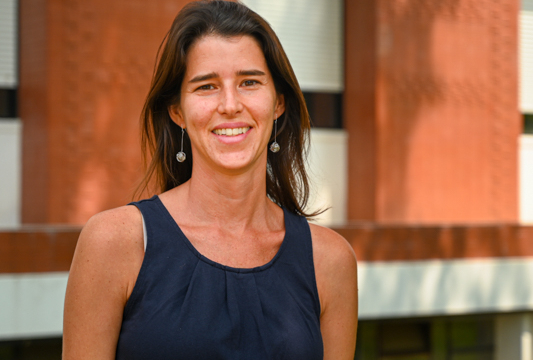
Marta Moita

Ph.D. in Biomedicine

Universidade de Porto, Porto


Investigador Principal
Telefone 21 446 4535
Exensão 535
Email
Local (Ala) Bioterio Upper (D1) - Sala 1D

Membros do Grupo

Kensaku Nomoto Postdoc
Tel: 21 446 4672
Andreia Cruz External Ph.D. Student
Tel: 21 446 4535
Marta Guimarãis 2006 PDIGC PhD Student
Tel: 21 446 4652
Ana Pereira 2008 PGCN PhD Student
Tel: 21 446 4514
Scott Rennie 2008 PGCN PhD Student
Tel: 21 446 4514
Elizabeth Rickenbacher 2009 INDP PhD Student
Tel: 21 446 4535


Projecto de Investigação

The role of A kinase anchoring proteins, AKAPs, in synaptic plasticity and memory formation.

In this project, we intend to investigate intracellular signals that lead to synaptic plasticity and the formation of new memories. Particularly, we are interested in understanding the protein kinase A (PKA) dependent signaling cascade, which has been implictaed in synaptic plasticity and memory formation. A new family of scaffolding proteins that bind PKA (A-kinase anchoring proteins, AKAP) has been recently discovered. Binding of PKA to AKAPs has been shown to be essential for the PKA-mediated phosphorylation of several proteins implicated in synaptic plasticity and memory formation. However, very few studies have addressed the specific role of the AKAPs in these processes. In this project, we intend to develop new tools to block the binding of specific AKAPs to their corresponding unique targets and test their effect in synaptic plasticity and memory formation.

Funding

POCI/BIA-BCM/56938/2004

Colaboradores

Evolution and Devolopment, IGC
Elio Sucena

Projecto de Investigação

The role of auditory cortex in associative learning

The amygdala, a structure in the temporal lobe, is crucial for the acquisition and recall of auditory fear conditioning. Information about the tone reaches the amygdala, either directly from the auditory thalamus, or indirectly via the auditory cortex. Lesioning each pathway alone does not affect the acquisition of auditory fear conditioning, but lesioning both impairs this form of learning. The contribution of each pathway to the acquisition of auditory fear conditioning remains unclear. We would like to study the role of the auditory cortex, the indirect route of auditory input to the amygdala, during auditory fear conditioning. In particular we would like to test the hypothesis that the auditory cortex is involved in providing specificity to the fear response, i.e. it is involved in establishing the degree of generalization to other tones that were not paired with shock.

Funding

POCTI/SAU-NEU/56935/2004

Projecto de Investigação

How do we associate stimuli separate in time: neural mechanisms underlyng trace auditory fear conditioning

The neural mechanisms underlying associative learning have been extensively studied and great progress has been made in the understanding of the cellular basis of this form of learning. Cellular mechanisms of associative learning are though to depend on correlated activity between connected neurons, where co-activation has to occur within a time window in the order of a few hundred milliseconds. However, animals can learn the association of stimuli that are correlated but occur with an interval of several seconds. This form of learning is thought to rely on working memory (that is, the ability to keep a representation of an event without sensory input, just like a memory buffer). The neural mechanisms of working memory, or any process that allows learning about the association of events separate in time, are poorly understood. In this project we propose to study this form of learning, using trace auditory fear conditioning (tAFC). During tAFC the tone preceeds shock delivery by several seconds. Despite the temporal gap between tone and shock delivery, animals still learn to fear the tone. Structures that have been implicated in some forms of working memory, such as the medial prefrontal cortex and the hippocampus have also been shown to be required for the acquisition of tAFC. We will study the role of the hippocampus and the amygdala in tAFC. In particular, we want to investigate which kind of information the hippocampus is processing during this form of learning, and how this information is conveyed to the amygdala.

Colaboradores

Brain Research Institute, UCLA
Hugh Blair

Publicações

Blair, H.T., Sotres-Bayon, F., Moita, M.A.P., LeDoux, J.E. (2005). The lateral amygdala processes the value of conditioned and unconditioned aversive stimuli Neuroscience 133(2) :561-9 Link

Moita, M.A.P., Erlich, J., Rosis, S., LeDoux, J.E. and Blair, H.T. (2004). Putting Fear in its Place: Remapping of hippocampal place cells during aversive contextual conditioning. Journal of Neuroscience 24(31) :7015-23 Link

Moita, M.A.P., Rosis, S., Ledoux, J.E. and Blair, H.T. (2003). Hippocampal place cells acquire place specific auditory responses during fear conditioning Neuron 37(3): :485-97 Link

Blair, H.T., Tinkelman, A., Moita, M.A.P., LeDoux, J.E. (2003). Associative plasticity in neurons of the lateral amygdala during auditory fear conditioning. In P. Shinnick-Gallagher, A. Pitkanen, A. Shekhar, and L. Cahill (Eds.), The Amygdala in Brain Function: Basic and Clinical Approaches Annals of the New York Academy of Sciences 985

Moita, M.A.P., Lamprecht, R., Nader, K. & LeDoux, J.E. (2002). Anchoring of PKA onto AKAP proteins in the amygdala is necessary for the consolidation of auditory fear memories. Nat. Neurosci. 5(9) :837-8 Link

de Bruin, J.P., Moita, M.P., de Brabander, H.M., Joosten, R.N. (2001). Place And Response Learning Of Rats In A Morris Water Maze: Differential Effects Of Fimbria Fornix And Medial Prefrontal Cortex Lesions Neurobiol. Learn. Mem. 75(2) :164-78